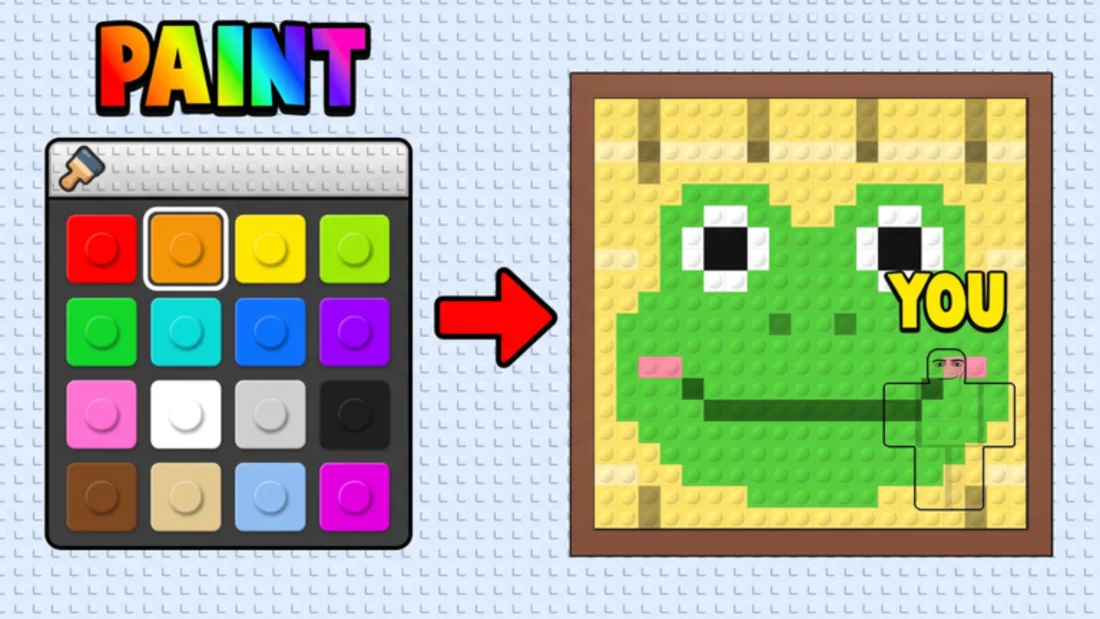
What you need before your first round
You do not need a code, a game pass, or a specific level to play Hide In Pixels. Open the official experience, join a server, and wait for a duel. The game supports PC, console, and mobile, so the first decision is simply which device gives you the most control. A mouse is the most precise painting tool. A controller and a touchscreen work, but they reward simpler patterns.
If you have the option, play your first round in a private server. The game offers free private servers, which means you can practice the palette and the timer without a stranger watching you learn. One private round is usually enough to understand the two phases: paint, then freeze. After that, public matches are the real test because the other player is actively looking for your mistakes.
Set one goal for the first match: finish a recognizable blend before the paint phase ends. Do not try to win the duel, use a troll item, or build a perfect character. A finished, simple blend teaches you more than an ambitious half-finished one.
- Open the official Hide In Pixels page and join a server or a free private server.
- Spend the first round learning the palette and the timer.
- Aim for a finished three-color blend, not a detailed character.
- Watch the seeker's route after you freeze; that route is your next round's information.
Read the painting before you touch the palette
The painting is not a reference photo. It is a grid of large color regions, and those regions are what the seeker will compare you against. Before you paint, find the two or three colors that cover most of the area around your intended hiding spot. Those are your base colors. A painting can have a dozen shades, but you rarely need more than three to disappear into a particular corner.
Look for the darkest shape and the lightest shape. Those high-contrast blocks are the ones that make a character silhouette obvious. If your chosen spot sits between a dark shape and a light field, your body needs a transition that copies that edge. If the spot is in the middle of a flat color, you need a very clean outline, which is harder than it sounds.
Spend five seconds on this step. It is the cheapest five seconds in the round, and it prevents the most common beginner mistake: painting a nice character, then standing somewhere the character does not belong.
Paint in passes, not in details
Think of the paint phase as three passes. The first pass fills the largest areas: torso, head, upper legs. The second pass handles the blocks that touch your outline: shoulders, hips, the sides of your head. The third pass is optional and should only be used if you have time left. Most rounds are won in the first two passes.
Start with the color that matches the background behind you, not the color of the painting's main subject. A common beginner move is to copy the bright character in the painting while standing in a dark corner. The colors are correct for the picture, but wrong for the player. Your character only needs to match the part of the painting that will be directly behind and beside it.
Keep your pattern blocky. Small details cost time and create more edges for the seeker to notice. A character made of four or five large color fields is easier to read as part of the painting than a character made of twenty small ones.
| Pass | What to paint | Time budget |
|---|
| First | Torso, head, upper legs in the dominant background colors | About half the paint phase |
| Second | Shoulders, hips, sides of the head, feet | Most of the remaining time |
| Third | Small highlights or dark accents | Only if the timer allows |
Choose a spot while you paint
Do not wait until the freeze to find a hiding place. Pick a spot early and paint for that spot. The best positions are usually near the edge of a large color region, where the painting already has a natural break. A shape at the boundary between two colors looks less suspicious than a shape in the center of a flat area.
Avoid the obvious hiding places: behind the frame, under a large prop, or directly in front of the painting's main subject. Experienced seekers check those first. A better spot is a boring part of the painting that still has enough color variation to absorb your outline. The middle of a busy pattern is often safer than the corner everyone tests.
Once you pick a spot, do not change it unless the seeker's route makes it impossible. Repainting your character for a new spot uses the time you need to settle. A committed average spot beats an uncommitted perfect one.
Freeze like you belong there
The freeze is not just a rule. It is a performance. The seeker is looking for a character that is trying not to be seen. If your camera is spinning or your character is adjusting position at the last second, the movement gives you away before the color does. Stop input, settle into the spot, and let the character stand still.
Keep your camera angle consistent with the painting. If you are hiding low, look low. If you are hiding near a vertical shape, align your body with that shape. The seeker may only see you for a second, and that second should look like a continuation of the picture.
The hardest part is patience. When the seeker walks past, the instinct is to move or use an item. Resist it. Most seekers double back, and a player who stays still through the first pass often survives the second.
When the timer is running out
If there are ten seconds left and your character is still mostly unpainted, stop trying to finish. Pick the single color that covers the most background around you, fill the largest visible blocks, and freeze. A rough silhouette in the right place is better than a detailed character caught in the open.
If you have already painted but have not chosen a spot, take the nearest area that shares your two main colors. Do not run across the map looking for a better match. The seeker notices movement, and a late sprint is the loudest thing you can do.
If you are already hidden and the timer is short, do nothing. The last few seconds are for settling, not for improvement. The urge to add one more block is what turns a safe round into a loss.
Your first five matches: a simple plan
Match one: finish a three-color blend. Match two: pick your spot before you paint. Match three: break your outline on the shoulders and feet. Match four: stay still through the seeker's first pass. Match five: add one troll item only when the seeker is close. By the fifth match you will have a repeatable routine, which is more valuable than a lucky hiding spot.
Do not judge progress by wins alone. Judge it by whether you finished the paint on time, whether your spot matched your colors, and whether you moved after freezing. Those three habits produce wins over a session, even if a single round goes badly.