How many paintings are in Hide In Pixels?
The official description says "tons of pixel paintings" but does not publish a number. The rotation can change with updates, so treat any exact count as unverified.
Round system
Every round is a new painting. The composition decides where a character can hide, not the palette.
Updated
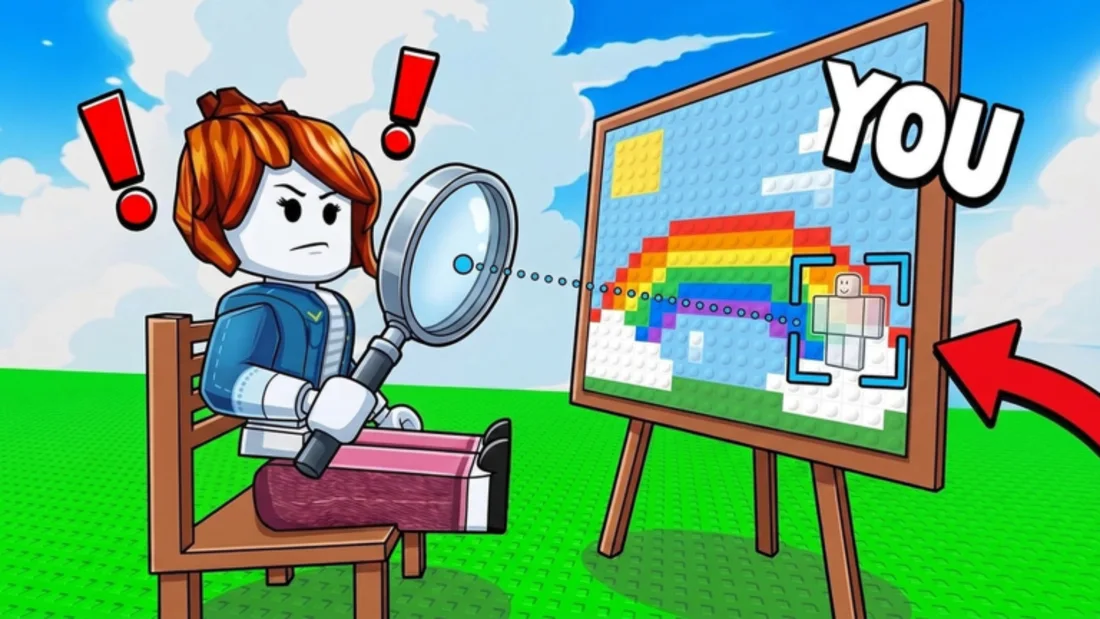
A Hide In Pixels painting is a large pixel-art image made of colored blocks. The game gives both players the same image and the same palette, then asks them to paint their block character so it can stand inside the picture without looking out of place. The painting is not a backdrop that scrolls or changes during the round. It is the entire map.
That is why the painting's composition matters more than its subject. A painting of a bright character on a plain background is hard to hide in because the background gives you nothing to work with. A painting of a busy scene with many small color changes is easier because the eye has more information to sort through. The best hiding paintings are not the prettiest ones; they are the ones with the most usable edges.
The official description says the game has "tons of pixel paintings." It does not publish a complete list, and the rotation can change with updates. This page explains how to read any painting rather than pretending there is a fixed catalog.
Most paintings fall into one of three practical types. A flat painting has large areas of one or two colors, such as a sky, a wall, or a simple background. A busy painting has many small shapes and color changes. A subject-heavy painting puts a large character or object in the center and leaves the rest as support.
Each type creates a different problem. Flat paintings punish outlines: there is nowhere to hide a hard edge, so the player must create a transition with the few blocks available. Busy paintings punish bad placement: there are many possible spots, but most of them are in the wrong part of the pattern. Subject-heavy paintings punish players who copy the subject: the seeker is already looking there.
The fastest way to classify a painting is to squint. When the details blur, which areas become solid blocks of color? Those are the regions the seeker will see first. If your character can join one of those regions, you have a chance. If it cannot, you need a different spot.
| Painting type | What it rewards | What it punishes |
|---|---|---|
| Flat | Clean silhouettes and precise color matching | Hard outlines and last-second repainting |
| Busy | Placement inside the pattern | Standing in the open between shapes |
| Subject-heavy | Hiding away from the main subject | Copying the subject and standing next to it |
First, find the largest color area. That is the region the seeker will scan most quickly, and it is usually the easiest place to blend if your body can match it. Second, find the darkest shape. That is where a head or shoulder outline can disappear. Third, find the busiest area. That is where a small mistake is most likely to be forgiven.
Fourth, find the main subject. Do not hide on it or directly beside it unless you can become part of its silhouette. The seeker's attention goes there first. Fifth, find the edge of the painting. The frame is an obvious check, but the area just inside the frame is often ignored because players assume the seeker will look at the center.
You do not need to memorize the painting. You need to choose a region and a body color before the palette opens. The players who spend the first ten seconds deciding are the ones who run out of time on the outline.
The painting is the same for both players, but the round is not symmetric. The first player paints and hides; the second player hunts. That means the same painting can be easy for one role and hard for the other. A painting with a huge flat sky is easy to hunt in because any outline stands out. A painting with a dense pattern is hard to hunt in because there are many shapes to check.
The seeker's route also changes the painting's difficulty. A seeker who checks the frame and the main subject first will miss a player in the busy middle. A seeker who sweeps in a grid will find that same player. The painting sets the board; the route decides how the board is read.
If you get the same painting in a later round, do not assume the same spot will work. The other player has seen your blend and knows where to look. Move to a different region and apply the same reading process.
The game's painting rotation is tied to updates, and the official description does not list every image. A page that claims to have the full catalog is usually guessing or copying another site. The useful approach is to learn the composition types so a new painting is a variation on a familiar problem, not a surprise.
When a new painting appears, check three things: the dominant color, the darkest shape, and the busiest region. Those three answers cover most of the decision. The exact subject matters less than the regions around your chosen spot.
If a painting is added or removed in an update, the advice on this page still applies. The specific hiding spots change; the way you read the image does not.
The easiest paintings are not the darkest or the busiest. They are the ones with a strong color region near the edge of the image. At the edge, the player has a natural boundary on one side and a large field on the other. The body can join the field while the edge hides the outline.
The second easiest type is a painting with a large dark subject and a mid-tone background. The dark shape gives the player a place to put the head and shoulders, and the mid-tone background absorbs the rest of the body. The subject itself is a decoy because the seeker checks it first.
The hardest paintings are the ones with a single flat color and a centered subject. The flat color exposes every edge, and the centered subject pulls the seeker's eye to the middle. In those paintings, the best spot is often the least interesting corner, not the area around the subject.
Players often ask for a list of painting names. The game does not present paintings like collectible cards with official names in the description, and the community uses descriptive names such as the frog, the panda, the penguin, or the rainbow. Those names are useful for conversation but not reliable as a catalog.
This site uses descriptive names when referring to an example, and it does not claim they are official. If you are trying to identify a specific painting, describe its dominant colors and subject rather than relying on a name you saw in a video.
FAQ
The official description says "tons of pixel paintings" but does not publish a number. The rotation can change with updates, so treat any exact count as unverified.
Yes. The round gives both players the same image, but one player paints and hides while the other hunts, so the painting plays differently from each role.
There is no best painting in general. Flat paintings reward clean outlines, busy paintings reward placement, and subject-heavy paintings reward hiding away from the main subject.